✦ Exploring the timeless wisdom of Jain philosophy through stories ✦
The Unbreakable Monk – Acharya Manatunga
The story of how Acharya Manatunga, chained in a dark prison by a king, came to compose the legendary Bhaktamar Stotra.
In the city of Ujjayini, Maharaja Bhoja held court like a man drunk on intellect. His assembly hall glittered not with gold — though there was plenty of that — but with the sharpest minds in the kingdom. Poets who could make stones weep. Orators who could turn an enemy into a friend between one sentence and the next. And among them all, none shone brighter than Vararuchi.
Vararuchi was a scholar of terrifying brilliance. His tongue was a blade, his memory a fortress. He had one daughter — Brahmadevi — and she had grown into a young woman of learning and beauty.
One evening, in the privacy of their home, Vararuchi turned to her and said, “You’ve come of age, daughter. Tell me — what kind of husband do you want?”
Brahmadevi’s face went cold.
“Father,” she said, her voice steady, “you should not speak such shameless words to your daughter. It is not our place to answer such a question. Girls of noble families would sooner die than say this from their own mouths.” She paused, then added, quieter, “And besides — all of this happens by destiny. What is meant to come will come.”
Vararuchi’s blood went hot. He was not a man who handled defiance well.
He stormed out of the house. “Watch,” he spat over his shoulder. “I’ll tie you to the neck of the biggest fool I can find.”
Rage took him from city to city, village to village. He wasn’t looking for a groom anymore. He was looking for a punishment.
And then he found one.
In a small town, he spotted a man sitting on a tree branch, cheerfully sawing it off — the same branch he was sitting on. Back and forth. Back and forth. Perfectly content, perfectly oblivious to the fact that he was about to send himself crashing to the ground.
Vararuchi stared up at him and thought: Perfect.
He coaxed the man down. Talked to him. Learned his name was Duryash — a Brahmin by caste, poor from the day he was born, and possessed of a face that could curdle milk. Vararuchi smiled for the first time in days. He brought Duryash home and stood him in front of Brahmadevi like a prize catch.
“Daughter,” he said. “Here is your groom.”
Brahmadevi looked at Duryash — this unwashed, slack-jawed stranger — and did not flinch.
“Whoever my father considers suitable,” she said, “I accept. This is what was in my destiny.”
They were married in an auspicious hour.
What else could it be but the bizarre nature of karma? A woman of learning and grace, bound to a man so foolish he would saw off the branch he sat on.
Days passed. The wedding was done. The house fell quiet.
And slowly — the way a bruise darkens after the blow — the anger drained from Vararuchi. What replaced it was dread.
What have I done?
He could already hear the whispers. Maharaja Bhoja would eventually want to meet his son-in-law. And of course he’d expect the son-in-law of the great Vararuchi to be a scholar of staggering ability. When Duryash opened his mouth in the royal assembly and revealed himself for what he was — Vararuchi would never recover.
He had to teach the fool. Something. Anything.
For months, he tried. Letters, syllables, the most basic verses. Nothing stuck. Duryash’s mind was a sieve made of air. Finally, Vararuchi abandoned all ambition and settled on a single goal: teach him to say Swastyastu — “May it be well.” Just one word of blessing. That was all. If Duryash could walk into court, say Swastyastu to the Maharaja, and walk out, they might survive.
It took a full year.
The day came. Vararuchi led Duryash into Bhoja’s glittering court, his heart hammering against his ribs. Duryash stood before the Maharaja. The entire assembly watched.
Duryash opened his mouth.
“Usharat,” he said.
Silence. The word meant nothing. It was gibberish.
Scholars turned up their noses. Eyebrows climbed foreheads. A murmur of contempt rippled through the hall. Vararuchi felt the floor tilt beneath him.
But Vararuchi had not survived decades at court by being slow.
He stepped forward, his expression one of calm authority. “A hall full of scholars sits here,” he said, his voice carrying, “and not one of them will pause to think before dismissing my son-in-law’s words? Is that how we treat learned speech in this assembly? Is it right to call a scholar’s utterance absurd without examination?”
The murmuring stopped. The court sat stunned. No one had an answer.
Vararuchi let the silence do its work, then spoke again. “Maharaja, the word Usharat is as much a blessing as Swasti. Allow me to explain.” He held up a finger for each syllable. “‘U’ stands for Uma — Parvati. ‘Sha’ for Shankar — Mahadev. ‘Ra’ — may they protect us. And ‘Ta’ — may the instruments of victory keep sounding.”
Maharaja Bhoja broke into a wide smile. “Of course,” he said. “If the son-in-law of a scholar like Vararuchi is not himself a scholar, then whose son-in-law would be?” He showered them both with rewards.
The assembly adjourned. Vararuchi walked Duryash out.
The moment they were out of sight, Vararuchi grabbed Duryash by the collar and kicked him. Once. Twice. A few more for good measure.
“You absolute donkey,” he hissed. “I taught you for a year. One word. Swastyastu. And you forgot it. If I didn’t have this brain in my skull, you would have buried me alive today.”
Duryash stumbled home with bruises on his body and something far worse burning inside him. Shame. Deep, corrosive shame.
That night, he left the house.
He walked to the monastery of Goddess Kalika, threw himself face-down at the entrance, and pressed his forehead into the cold stone.
“Mother,” he whispered. “Give me knowledge. Or take my life. I don’t want anything in between.”
For seven days he lay there. No food. No water. No movement. Just the name of Kalika running through his mind like a river that would not stop.
On the eighth day, the air inside the monastery changed. A warmth gathered around him. He opened his eyes, and she was there.
Kalika.
“Brahmin,” she said. “I am pleased with you. Kingdoms, treasure, wealth — ask me for anything.”
Duryash raised his head. “I want nothing,” he said. “Only Vachan-Siddhi. The power of speech.”
Kalika smiled. “Go, then. It is yours. And in this world, you will be known by a new name — Kalidasa.”
Duryash — now Kalidasa — stood up and walked out of the monastery. And as soon as his feet crossed the threshold, words started pouring from his mouth. Not ordinary words. Words that crackled with wit, dripped with double meaning, carried weight that could anchor ships.
People gathered. They stared. They asked how this was possible.
The grace of Kalika, they were told.
When Vararuchi heard, he went still for a long time. Then joy came. Then shame, hot and heavy, for having nearly ruined his daughter’s life over a moment of stubborn anger. But he could not deny the truth: destiny could not be changed. What was written had been written.
Kalidasa’s fame spread like fire in dry grass. Scholars who had once laughed at Duryash now bowed before Kalidasa. His influence grew, and his importance found a firm place in the heart of Maharaja Bhoja.
Time passed. One afternoon, a wealthy merchant named Seth Sudatta came to court, bringing along his young son, Manohar.
Bhoja greeted them warmly and looked at the boy. “He seems promising, Sethji. Have you had him educated?”
“His education has just begun, Maharaja,” said Sudatta. “He has only memorized the verses of a text called Namamala.”
Bhoja’s ears pricked up. “Namamala? I’ve never heard of it. Who composed it?”
“A great poet named Dhananjay, Maharaja. He lives right here in your city.”
Bhoja turned on the Seth. “You knew of such a scholar in my own city and never brought him to me? That was wrong of you.”
From across the hall, Kalidasa tensed. There was bad blood between him and Dhananjay. Hearing the Maharaja pour praise on another scholar set his teeth on edge.
“Maharaja,” Kalidasa cut in, “since when do ascetics and merchants study the Vedas? Where would these poor fellows get scholarship from?”
Bhoja waved this off. He was a man who loved knowledge the way other men loved conquest, and he would not be talked out of it. He sent a minister to bring Dhananjay to court.
Dhananjay arrived shortly — composed, confident, unhurried. He recited a blessing verse so elegant that the entire assembly sat up straighter.
Bhoja welcomed him. “I’ve heard you are a great scholar. It surprises me that we haven’t met until now.”
Dhananjay smiled. “Lord of mercy, you are the lord of the earth. Until the rise of one’s merit is strong enough, how can one hope to receive the gift of your sight? Today, my desires are fulfilled.”
Bhoja asked about his work. “Your name is well-known, but surely a small text like Namamala is not your only creation? You must have composed something grander.”
Before Dhananjay could respond, Kalidasa was on his feet again.
“Maharaja, that Namamala belongs to us. Its real name is Namamanjari. Only Brahmins can be its creators. What would merchants know about the core of the scriptures?”
The words landed like a slap.
Dhananjay’s smile vanished. His creation — being stolen from him, right there, in broad daylight. “Maharaja,” he said, his voice controlled but steel-edged, “this is a complete lie. I composed this text myself, for the understanding of children. Everyone knows this. Send for the book and examine it. It appears these people have erased my name, put their own in its place, and renamed it Namamanjari.”
Bhoja turned to the Brahmins, his face hard. “If this is true, you have committed a great injustice. Hiding another man’s work and claiming it as your own — if that isn’t theft, what is?”
Kalidasa didn’t blink. “Maharaja, this Dhananjay studied under a man called Manatunga who doesn’t have the faintest scent of real learning. How did such a student become a scholar overnight? Call Manatunga himself. Have him debate with us. His so-called scholarship will collapse on its own.”
Now it was Dhananjay’s turn to lose his composure. He could take insults to himself. Insults to his Gurudev were another matter.
“Who in this hall,” he said, heat rising in his voice, “has the scholarship to stand and debate at the feet of my Guruji? Let me see how much learning you carry first, Kalidasa. Debate me before you dare take his name.”
The debate began immediately.
They went back and forth — logic against logic, argument against counter-argument, across philosophy, grammar, scripture. Dhananjay wielded the razor-sharp precision of Syadvada, the Jain method of qualified assertion. He cornered Kalidasa again and again, leaving him grasping for footholds on ground that kept shifting beneath him.
Kalidasa, frustrated and outmatched, kept circling back to the same demand: “I will debate his guru. Bring Manatunga.”
Bhoja could see the truth clearly enough — Dhananjay’s arguments were stronger. But curiosity got the better of him. He wanted to see this Manatunga for himself. And Kalidasa would not rest until the challenge was met.
He sent a messenger to Acharya Manatunga.
The messenger found the Muniraj in his dwelling and bowed. “Bhagavan, Maharaja Bhoja, lord of Malwa, has heard of your greatness and wishes to see you. He has summoned you to the royal court.”
The Muniraj looked at the messenger with mild, untroubled eyes. “Brother, what business does an ascetic have at a king’s door? I don’t farm. I don’t trade. I don’t beg from anyone. Why would a king summon me?”
The messenger returned to the palace and relayed the Muniraj’s words.
Bhoja sent servants again. The Muniraj gave the same answer. They came a third time. Then a fourth. Each time, the same quiet refusal. No aggression. No defiance. Just the calm certainty of a man who had no use for palaces.
The fifth time, Kalidasa whispered something to the Maharaja, and Bhoja’s patience snapped.
“Bring him by force,” the king ordered. “By any means.”
The servants — who had been growing more irritated with each trip — needed no further encouragement. They went to the Muniraj, and this time there was no requesting. They brought him to the royal assembly by force and stood him before the entire court.
Acharya Manatunga stood in the centre of that great hall and said nothing.
He had recognized the situation for what it was — a calamity, a test of endurance — and had taken the only correct action. He fell into silence. Total, absolute silence. He withdrew into meditation, into the equanimity of a soul that knows it cannot be harmed by anything outside itself. His mind rested on the Pancha Parameshthi — the five supreme beings — and he let the world do what it would.
The king very much wanted him to say something. Courtiers approached him respectfully, requesting that he share a religious discourse. But not a single word came from his lips.
Kalidasa seized the opening. “Maharaja, this man was exiled from the Karnataka country. He is a great fool. He has seen the royal assembly and become terrified. That is why he cannot speak.”
Others tried. They pleaded. They reasoned. They flattered. But the Muniraj sat unmoved, like a mountain that had decided it no longer owed the wind an explanation.
Bhoja’s patience — already thin — shattered completely.
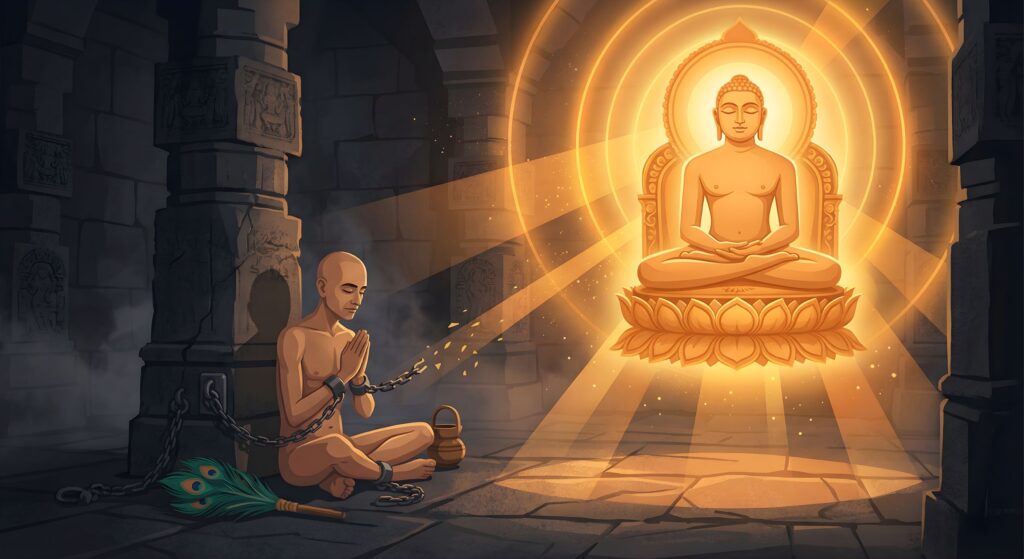
He ordered the Muniraj thrown into the palace dungeon. Not just any cell. Forty-eight cells, one nested inside the next, like the rings of a locked puzzle. Handcuffs. Fetters. Heavy iron chains. A strong lock on every door. Armed guards stationed at every entrance.
The darkness swallowed Acharya Manatunga whole.
Three days passed. Then the fourth arrived.
The Muniraj sat in that pitch-black innermost cell, chained and shackled, and he composed.
What he composed was not an appeal. Not a plea. It was a hymn.
On the fourth day, he began reciting the Adinath Stotra — the Bhaktamar Stotra — a poem of devotion to Lord Adinath, the first Tirthankara. Each verse hummed with a power that went beyond language. Yantras. Mantras. Riddhis. Not the loud, violent magic of worldly spells, but the quiet, irresistible force of a soul that had stopped wanting anything for itself and turned entirely toward the Vitaraga — the detached Lord.
He recited the stotra once.
Every lock in the dungeon fell away. The handcuffs cracked open. The fetters dropped from his ankles. One by one, the doors of all forty-eight cells swung wide with a sound like thunder.
The Muniraj walked out calmly and sat on the stone platform by the entrance.
The guards stared, their faces white. They said nothing to him and he said nothing to them. They simply locked him up again — every chain, every cell, every door.
Before long, the same thing happened. Every lock. Every chain. Every door. Open.
The Muniraj walked out again and sat in the same spot, as still as before.
This time, the guards ran to the king.
“Maharaja — the prisoner has freed himself again. We don’t know how.”
Bhoja frowned. “Negligence,” he said. “Lock him up again. Post more guards. Watch every door.”
They did. Every precaution doubled.
It made no difference. The locks fell. The chains broke. The doors flew open.
Acharya Manatunga walked out a third time.
But this time, he did not sit on the platform.
He walked — unhurried, unchained, radiating a silence so deep it made the air vibrate — straight into the royal assembly.
The moment he entered, Maharaja Bhoja felt his throne tremble beneath him. Not a metaphor. The seat itself shook, as though the ground had decided it would no longer hold a king who had imprisoned a saint.
Bhoja turned to Kalidasa, his face tight with fear. “Kaviraj — my seat is shaking. Do something. I cannot stay on this throne another moment.”
Kalidasa leapt into action. He sat cross-legged, closed his eyes, and began chanting — fierce incantations, dark syllables meant to summon the same Goddess Kalika who had given him everything. Worldly magic. Brute force of will. The same power that had made him famous.
But the assembly hall was no longer the same room it had been an hour ago.
Acharya Manatunga stood in its centre, and around him radiated something that no spell could touch. It was not loud. It was not dramatic. It was the absolute stillness of a consciousness that had been purified by devotion, stripped of all want, all fear, all anger. The Bhaktamar Stotra still echoed in the walls, in the air, in the stone beneath their feet.
Kalidasa’s spells dissolved like smoke hitting a wall of water.
He chanted harder. Nothing. He called out to Kalika with everything he had. Nothing came. The fierce magic he had wielded his entire career simply refused to exist in the same space as the Muniraj’s presence.
The entire court saw it happen.
Saw worldly power — conditional, borrowed, dependent on the whims of a goddess — collapse before the quiet, invincible strength of a soul surrendered to the supreme Vitaraga.
It was not a defeat. It was an education.
Kalidasa opened his eyes. For the first time in his life, the poet had no words.
He understood now — in his bones, not just his mind — the difference between seeking worldly boons and attaining true spiritual purity. Between magic that was given and could be taken away, and a power that arose from within because there was nothing left inside to obstruct it.
Maharaja Bhoja rose from his trembling throne. His pride — the pride of a king who had imprisoned a holy man for refusing to perform on command — crumbled away like old plaster.
He crossed the hall. Kalidasa followed. The courtiers who had mocked and plotted followed. One by one, they fell at Acharya Manatunga’s feet.
“Forgive us,” Bhoja said. “Forgive our ignorance. Forgive our cruelty.”
The Muniraj looked at them with the same mild, untroubled eyes he had shown the very first messenger. He had never been angry. There was nothing to forgive, because there had never been a wound.
That day, Maharaja Bhoja took the vows of a Shravak from the Muni Maharaj. He finally understood what his palace full of scholars and poets had never been able to teach him — that true refuge lies only in the Lord himself, beyond all magic, beyond all intellect, beyond all power.
And from that day forward, the glory of Jainism spread through his kingdom and into the world beyond.