✦ Exploring the timeless wisdom of Jain philosophy through stories ✦
The Past Lives of Mahavira- Part 1 of the Vardhamana Charitra
This is the story of the soul that would one day become Bhagavan Mahavira — told across thirty-seven births.
Stories from the Vardhamana Charita of Poet Asaga
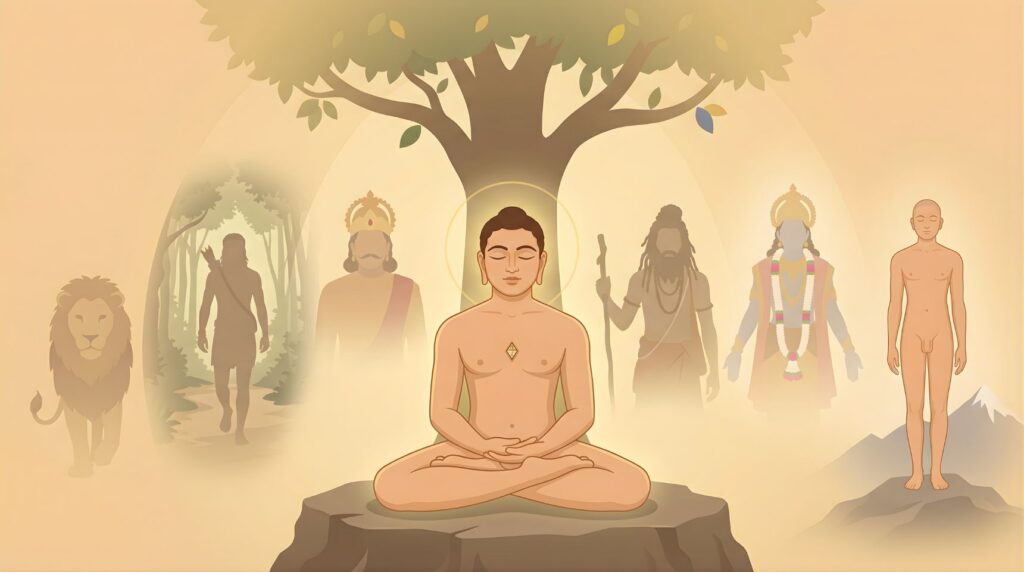
About This Story
The past lives of Mahavira traces the journey of a soul across thirty-seven births — the soul that would one day become the 24th Tirthankar of the present era.
It was written by the poet Asaga in the ninth century, under the guidance of Muni Bhavakirti. The original text is called the Vardhamana Charita. Now it is retold it in English, keeping every episode faithful to Asaga’s original.
The story is published in six parts:
Part 1 — A prince, a monk, and the story of a lion (Chapter 1–3)
Part 2 — A disputed garden and a march to war (Chapter 4–7)
Part 3 — The battle, a descent to hell, and a brother’s moksha (Chapter 8–10)
Part 4 — Lives of rising virtue (Chapter 11–14)
Part 5 — The sermon on reality and a final renunciation (Chapter 15–16)
Part 6 — The life of Bhagavan Mahavira (Chapter 17–18)
Chapter One: The Prince Who Walked Away from Pleasure
In the south of Jambudvipa lay the Bharata region — that ancient field where worthy souls had always flourished, watered by the rain of Jinendra’s dharma. And in its eastern reaches, there was a land so radiant that even the gods of heaven envied it: a country of gem-filled mines, lush elephant forests, and fields that bore crops effortlessly, as though the earth itself were eager to give.
In that land stood the city of Shvetatapatra — the City of White Parasols.
It was a city that seemed to mock the heavens. The sun, for all its thousand rays, could not climb its ramparts; the blue lustre pouring from the tops of its cloud-high walls made it look as though Rahu, the devourer of light, had taken up residence there. Jain temples lined its avenues, so beautiful that even those who held no faith in Jinendra’s words would stop and stare, drawn in by sheer wonder. Inside the grand mansions, floors of flawless crystal caught the reflections of women’s faces, and bees would dive toward them, mistaking those reflections for real lotuses. Baby deer, once tricked by the emerald-green light spilling from palace thresholds — light they’d confused for grass shoots — grew so wary that they refused to eat even real grass placed before them.
It was a city of marvels. And its king was a man named Nandivardhan.
Nandivardhan was everything a king should be — generous as a wish-fulfilling tree, fierce as a forest fire to his enemies, yet moist with compassion at his core. Even those who came to him as foes, seeking refuge, found shelter. His queen was Veervati, a woman who seemed to be radiance itself given a body. She adorned Nandivardhan the way lightning adorns a fresh cloud, the way a new blossom adorns a mango tree.
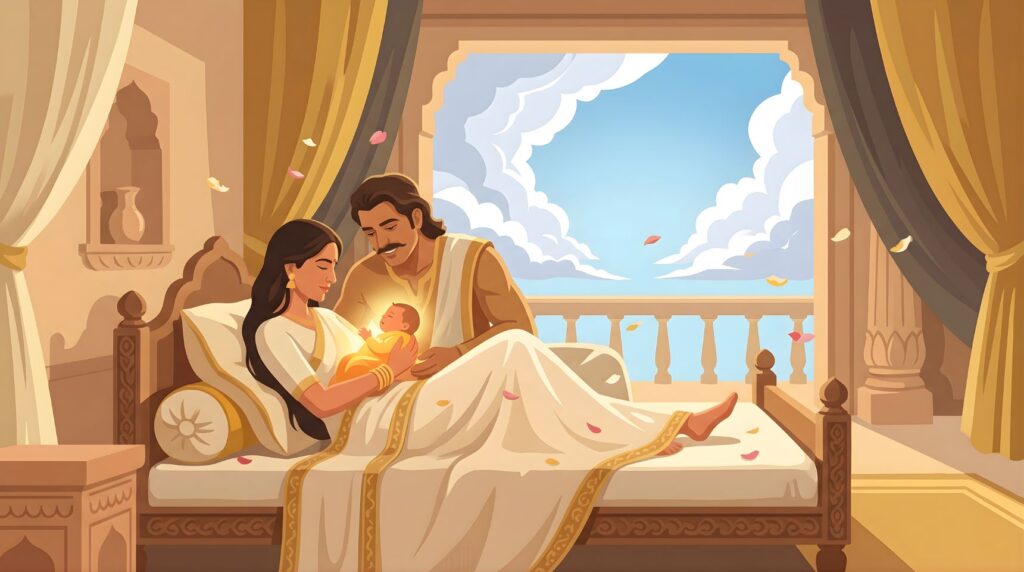
From their union, a son was born.
At the moment of his birth, the sky cleared. The earth trembled with love. Fetters broke on their own, somewhere, as though the world itself were loosening its grip. A gentle, fragrant breeze swept through the city. On the tenth day, the king named his son Nandana — “the one who delights” — because the child had already delighted every heart that beheld him.
Even in childhood, Nandana mastered every branch of learning. His arms bore the calluses of the bowstring. When youth arrived — that dangerous season that makes fools of kings and beggars of princes — Nandana did something rare. He conquered it. Not the enemies outside the walls, but the ones within: the invisible army of pride, lust, and craving that youth summons to the gates of every young man’s mind. He defeated them single-handedly, without anyone even noticing a battle had taken place.
One day, with his father’s permission, Nandana rode out with his companions to a pleasure-garden on the city’s edge — a place of artificial hills and lush trees, the air heavy with flower-scent stirred by the Malaya breeze.
They wandered, they ate, they laughed. And then, when their senses were satisfied and the afternoon had gone quiet, Nandana saw something that changed him.
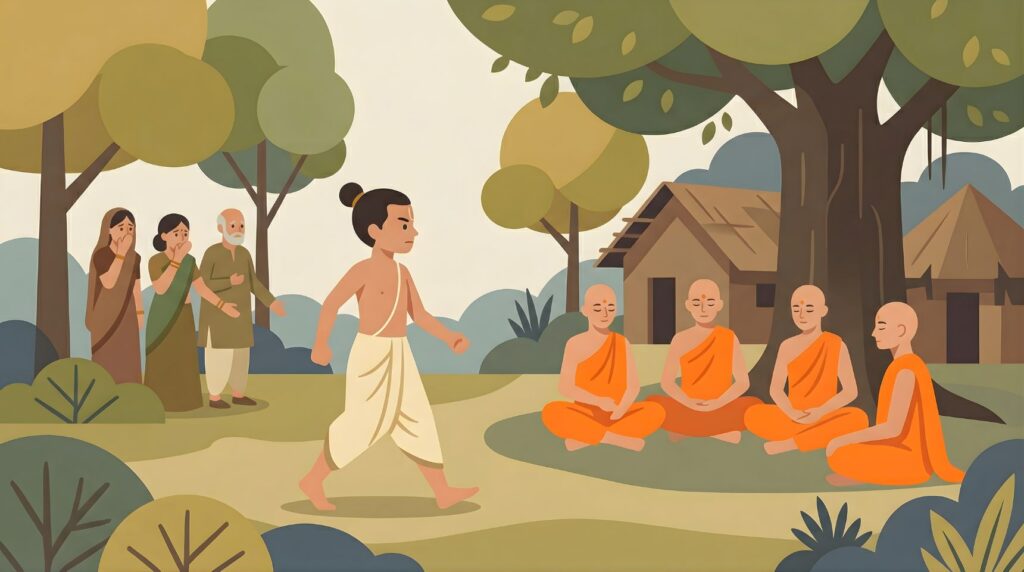
Beneath a beautiful Ashoka tree, seated on a high slab of spotless crystal, was a monk named Shrutasagar. He sat perfectly still, his body lean from austerity, his face luminous with a calm that no pleasure-garden could give.
Nandana stopped. From a distance, he bowed — not the shallow bow of protocol, but a full prostration, his body pressed against the ground. Then he approached, touched the monk’s feet with his lotus-soft hands, and sat near him.
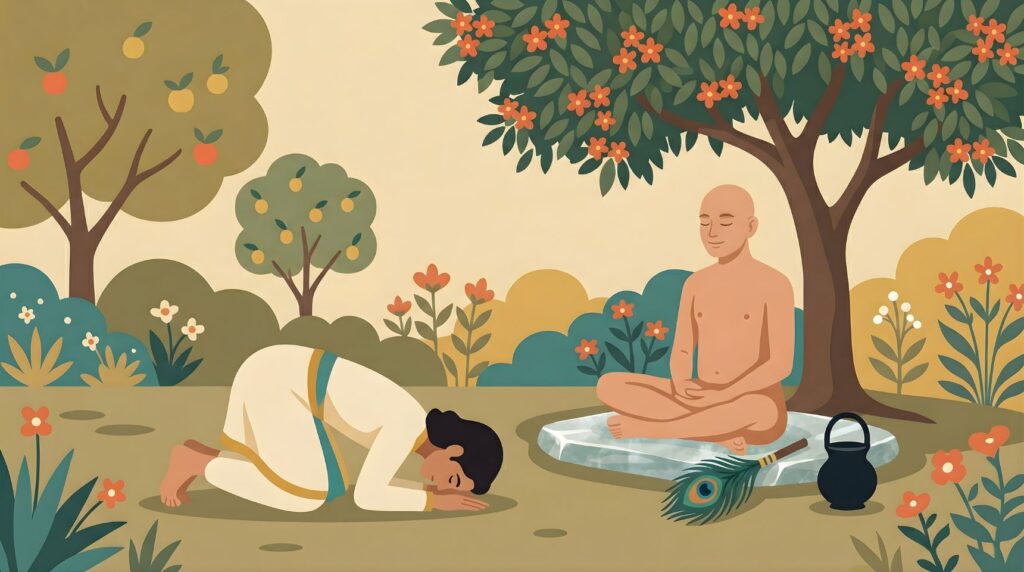
“Lord,” he said, his palms joined like a bud about to open, “how does the soul cross this terrible ocean of worldly existence? How does it reach liberation?”
The monk looked at him. And then he spoke.
“As long as you cling to the thought this is mine — as long as that futile grasping persists — your face remains turned toward Death. But the moment you realize the true nature of the self, through the self alone, liberation comes.”
Something broke open in Nandana. It was like a lotus pond suddenly stirring to life at the touch of the first light. A darkness he hadn’t known he carried — the darkness of mithyatva, of false belief — shattered. In its place, a clarity he had never experienced.
He accepted vows from the monk. He stayed in his company a long while, drinking in his presence. And when he finally rose to leave, he walked home counting the monk’s virtues in his mind, the way a jeweler counts gems.
His father made him Crown Prince on an auspicious Thursday, with great ceremony. And Nandana proved himself worthy. He rewarded those who had served him since childhood. He enjoyed the pleasures that befitted a king, but abandoned every pleasure that was a seed of suffering. Power could not intoxicate him. The freshness of his new authority, the beauty of his youth, the wealth at his command — none of it touched him. He worshipped in the Jain temples with supreme devotion. He listened to the life-stories of Jinendra from great monks. He observed his vows in the proper manner.
At his father’s wish — and only at his father’s wish — he married Priyankara, a woman whose beauty surpassed even that of celestial women. She, too, by her husband’s influence, took up samyaktva and drank deeply of dharma. And with her gentleness, her modesty, her conduct — with the slow, irresistible accumulation of her virtues — she held her husband in her sway. Not through seduction. Through goodness.
Chapter Two: A Cloud, a Crown, and a Forest in Spring
Years passed. King Nandivardhan, having placed the burden of the kingdom on Nandana’s capable shoulders, lived contentedly with Veervati, free from worry. His son was everything he could have hoped for — a man who governed as though ruling were breathing, who gave with such generosity that petitioners received more than they’d dared to ask for.
But one evening, standing on the terrace of his palace with his queen beside him, Nandivardhan looked up at the sky and saw a cloud.
It was enormous — a white, magnificent thing, its peak rising like a dome of foam on the ocean. He watched it with wonder. It seemed as permanent as a mountain. And then, even as he stared, the wind tore it apart. In an instant, that vast, solid-looking cloud dissolved into nothing. It was simply gone.
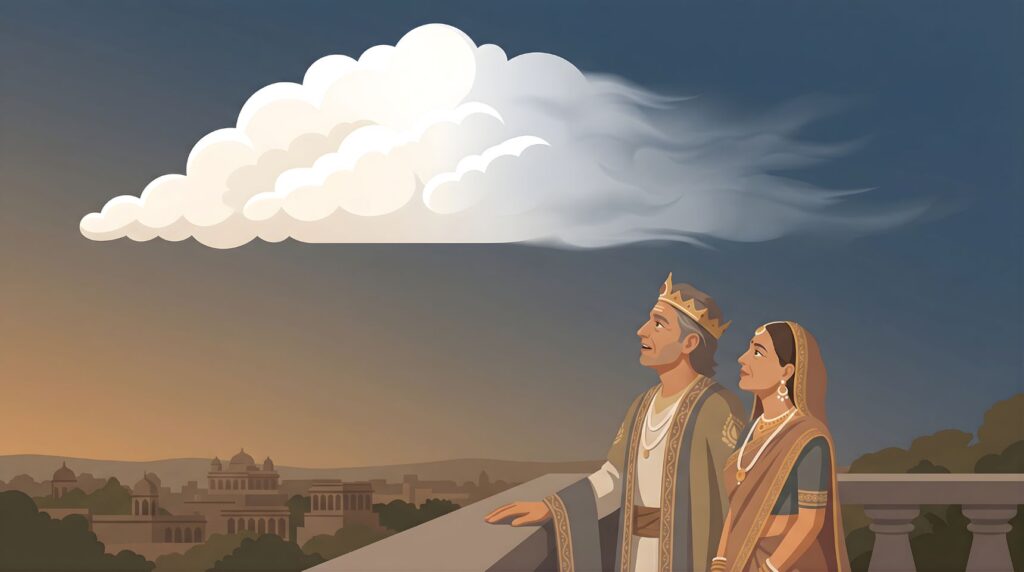
Nandivardhan stood very still.
Just like that cloud, he thought. Youth. Wealth. Life itself. They look so solid. And then they’re gone.
The thought went deeper.
It is craving — trishna — that keeps the soul imprisoned. Craving is the cage. And the cage is full of suffering.
He thought about how rare a human birth was — obtainable only after crores of births in the ocean of existence. And rarer still than human birth was a good country, a noble family. And rarer than all of these was a mind that genuinely desired its own spiritual welfare.
I have all of these, he thought. And I’m standing on a terrace, watching clouds.
He came down from the terrace. He walked to the assembly hall, sat upon his throne, and looked at his son.
“Nandana,” he said. “For a very long time I have nourished this kingdom. Now I am placing the crown and the burden of the people upon your head. I wish to go to the forest of austerities. Do not stand in my way.”
Nandana listened. He reflected. Then he joined his palms and spoke.
“Father, you have seen that this royal fortune is not beneficial to the soul, and so you’re renouncing it. Then how can I — today — accept the very thing you’ve found disagreeable? The very thing that goes against my own nature?”
He paused.
“Don’t you know that without following in your footsteps, I cannot sit still even for a moment? When the sun sets, does the day linger? Give me diksha too. What use is a kingdom to me? A kingdom is nothing but an abode of calamities.”
His eyes sharpened. “Father — you want to put this terrible serpent of kingship around my neck and then walk off into the forest to practice austerities? That’s the conduct of an enemy, not a father.”
Nandivardhan was delighted by his son’s words. Truly delighted. But he was also a practical man.
“Your words are worthy of our lineage,” he said. “But if we both leave together, people will say the father destroyed the family by dragging his son along. Stay home. Govern. For some days.”
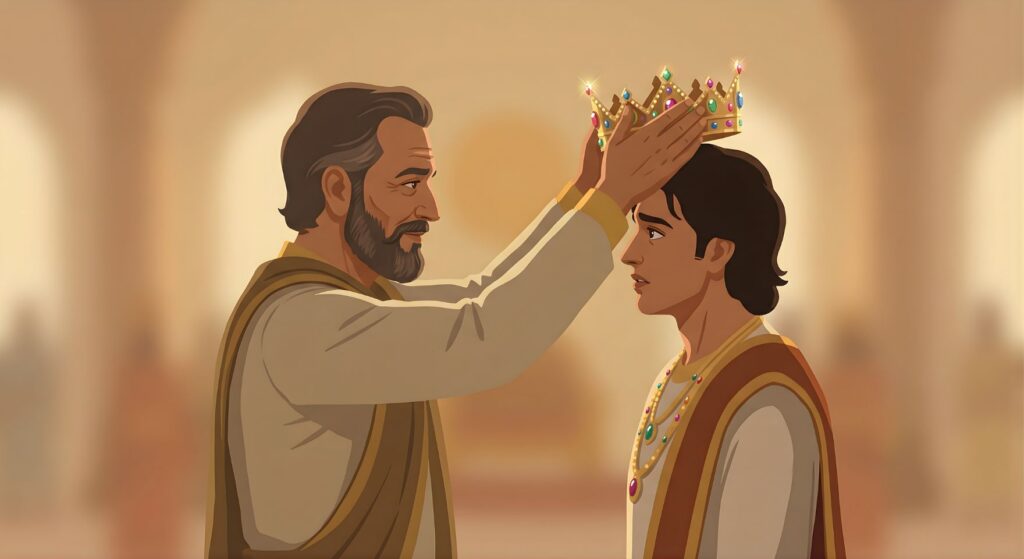
And before Nandana could protest again, the king took the crown from his own head — that crown whose multicoloured gems caught the light like a piece of Indra’s rainbow — and placed it on his son’s head.
Then he turned to the assembled kings and ministers. “I place this son in your hands,” he said, “like a deposit entrusted to great souls. Guard him.”
He bid farewell to his wife, his friends, his relatives. As he walked away from the palace, the sound of wailing followed him. He did not look back. His mind and his gaze stayed fixed on what lay ahead.
He took diksha under the monk Pihitasrava, along with other kings who had also resolved upon renunciation.
Nandana grieved. Even the ocean grieves when the moon departs. But his ministers and brothers consoled him, and one day the court addressed him plainly: “Set aside your sorrow, lord. Tend to the people. It is the weak who are conquered by grief.”
He listened. He cast off his sorrow and took up his duties. And within a few days, through wisdom alone, the young king had won over even hostile enemies — not by the sword, but by the sheer force of his character. It was no great wonder that fickle Fortune, having found him, became steady. What was truly remarkable was that his fame, already spread across the earth, kept spreading further.
Queen Priyankara gave birth to a son named Nanda, who grew day by day like the waxing moon.
And then spring arrived.
It came carrying an offering of newly blooming flowers and tender leaves, sweeping in from the south with the tremors of the Malaya breeze. It stripped the old leaves from the trees and dressed the forest in fresh shoots, buds, and blossoms. Bees gathered around mango trees the way relatives gather around a generous man about to receive great wealth. The Ashoka tree bristled with clusters of buds from its very roots, as though its hair were standing on end with delight at the touch of beautiful women’s feet. The Champaka flower, though blessed with incomparable fragrance, was ignored by the bees — for how can those of dark nature love what is truly fragrant?
A cuckoo perched on a mango tree by the roadside seemed to be scolding a passing traveler with its song: Turn back! Go home to your beloved! Why do you wander and suffer?
It was in this season, while roaming through the flowering forest, that the royal forest-keeper saw something unexpected.
In a quiet part of the woods, a monk sat in deep meditation. His name was Proshthila, and he possessed avadhi-jnana — clairvoyant knowledge, the ability to see what ordinary eyes could not.

The forest-keeper bowed with all his heart and then ran to the city. The news he carried was sweeter than spring itself.
When King Nandana heard that a monk was present in the grove, he rose from his throne the way the ocean rises at the sight of the moon.
Through meritorious karma, he thought, even the sight of great saints is obtained. And from that sight, one gains the nectar of dharma — the only medicine that can cure the terrible disease of worldly existence.
He summoned his inner circle and the royal women, called for bodyguards and vehicles, and set out. Mounted on a magnificent elephant, surrounded by kings in ceremonial dress, watched from the rooftops by the lotus-eyed women of the city — the king of kings rode toward the forest to meet the monk.
Chapter Three: The Lion on the Mountain
The fragrant Malaya breeze met King Nandana at the edge of the forest like a brother greeting a brother — both southern in nature, both generous. He dismounted from his elephant while still far from the monk’s seat — a gesture of humility that said more than words could. He removed his royal parasol and every insignia of kingship. He abandoned even the steadying hand of his attendant.
And then he saw him.
The monk Proshthila sat on a spotless crystal slab beneath a red Ashoka tree. He appeared as though Right Dharma itself had taken a seat at the summit of the world.
Nandana circumambulated the monk three times, his palms joined and raised to his crown. He bowed. Then he sat on the ground nearby and spoke, his voice trembling with joy.
“Bhagavan — does not bliss arise in the hearts of worthy souls simply from seeing you? Just as it arises from the sight of samyag darshana itself?”
“Lord, without any desire on my part, merely by seeing you, I am completely fulfilled.”
Then he leaned forward. “O Compassionate One — I wish to hear from you the succession of my births.”
The monk, who possessed the eyes of complete avadhi-jnana and saw the past as clearly as most men see the present, began to speak.
“O Jewel among the Worthy,” he said. “I shall narrate your past births exactly as they were. Listen with one-pointed mind.”
The Lion

“In this Bharata region, the monk said, “there flows the river Ganga, born from the Padma lake of the Himavat range — a river that seems to laugh at all other rivers with her foam. On her northern bank rises a mountain called Varaha, whose peaks leap so high they seem to be trying to behold heaven itself.”
“O King of Kings — in the ninth birth before this present one, you were a lion on that mountain.”
Nandana sat very still.
“That lion,” the monk continued, “was a terrifying creature. His vast mouth was made fearsome by the tips of fangs that rivalled the crescent moon. The curling mane on his neck was tawny like the flames of a forest fire. His brows arched like drawn bows. His eyes blazed like burning meteors. His tail rose high in a graceful curve, like a banner.”
“With his upraised forequarters, he seemed to be leaping at the sky itself. His hide had the dark lustre of night-lotuses blooming under dense moonbeams. On the mountain peak, he would challenge the thundering clouds with his own roar. He would scatter other creatures with his sharp, keen claws, and chase elephants as they fled through the ravines and groves. He dwelt on that mountain freely, for a very long time, the unchallenged king of all he surveyed.”
“One day, having killed a wild elephant-lord, the lion lay weary at the mouth of his cave. Lying there in the half-light, he looked like a causeless smile upon the face of the mountain.”
The Two Monks Who Descended from the Sky
“At that moment,” the monk Proshthila continued, “two holy monks named Amitakeerti and Amaraprabha, travelling through the sky-path, came upon the sleeping lion and saw him.”
“They descended. Those two foremost sky-faring Charana monks — compassionate, fearless, possessed of melodious voices, and exceedingly wise — sat down at the base of a Saptaparna tree, on a gemstone slab. And then, to awaken the lion, they began reciting the sacred Prajnapti text in a loud voice.”
“The sound shattered the lion’s drowsy slumber. And something extraordinary happened. In that instant — as the words of the Prajnapti entered his ears — the king of beasts abandoned his innate cruelty. Just like that. It was as though a door had opened in a room that had been dark for lifetimes.”
“With his ears and tail drooping low, the lion emerged from the mouth of the cave. He cast aside his fearsome appearance and approached the monks. His eyes widened with the joy of beholding their faces. He sat down before them with a demeanour so peaceful it would have astonished anyone who had seen him tear apart that elephant only hours before.”
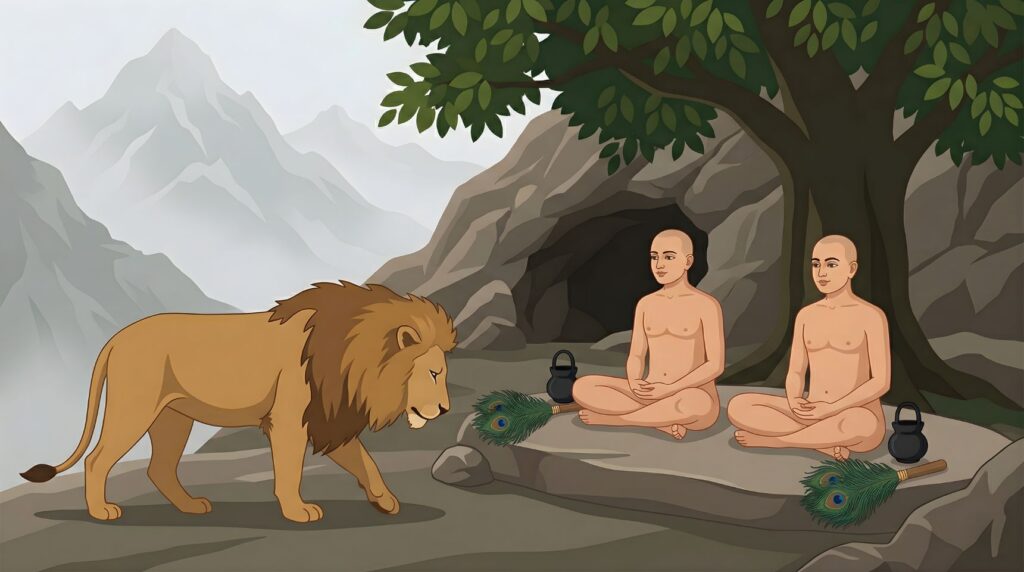
“Seeing him, the noble-minded Amitakeerti spoke:
”’Alas, O King of Beasts! Without attaining the right path, you have become like this. It seems you have conducted yourself with the fearlessness of a lion not merely on this mountain, but also in the terrible, beginningless forest of worldly existence.”’
“Then the monk taught. He spoke of the jiva — the soul — a substance without beginning or end, that undergoes transformation, that experiences the fruits of its own karma, that is the doer of its own bondage, and that is characterized by knowledge.”
“‘The soul with attachment binds karma,’ the monk said. ‘The soul free from attachment sheds karma. This is the teaching of Bhagavan Jinendra, stated in brief, regarding bondage and liberation.”
‘Therefore, O Lion — abandon the poison of mithyatva together with attachment and the other flaws. The conditions for liberation have not yet been attained by you. But know this: attachment and aversion are the root cause of karmic bondage. By their increase, even samyaktva is destroyed.”
“Then the monk Amitakeerti leaned forward and said: ‘O Lion — the succession of births through which you have wandered on account of these flaws — make your ears a vessel for my words and hear that now.'”
The Hunter and the Monk
“And so, sitting before the lion on that mountainside, the monk Amitakeerti began to narrate.
“‘In the eastern Videha region, there is a city called Pundarikini. In that city, there once lived a righteous caravan-leader named Dharmasvami. Once, he was travelling with a great caravan. Journeying alongside them was a monk named Sagarasena — a celebrated treasury of austerities.
The caravan was attacked. Robbers fell upon it without warning. Brave men were killed. The frightened ones fled toward Ratnapura. The entire caravan scattered like seeds in a storm.
“‘The monk, now alone and lost, wandered into the Madhuvana forest. There he encountered a tribal hunter named Pururava, who lived in the forest with his wife Kashi.
“‘Pururava was a violent man. He killed for his living. But something about the monk’s presence broke through. Even this hunter — cruel by nature — accepted dharma upon hearing the monk’s words. He escorted the monk a great distance through the forest, set him on the right path, and watched him disappear safely into the distance.

“‘Pururava kept his vows of ahimsa and other vows for a long time after that. When he died, he was reborn as a god named Pururava in the Saudharm heaven, with a lifespan of two sagaropamas.”‘
Marichi, Grandson of the First Tirthankara
“‘In that heaven,’ the monk Amitakeerti told the lion, ‘Pururava the god drank the nectar of divine happiness for a very long time. But merit is not inexhaustible. When it was spent, he fell.
“‘He was born in the city of Vineeta — a city so magnificent it seemed as though Indra himself had fashioned it by extracting the very essence of heaven. A city where the radiance of gem-studded ramparts blocked the approach of darkness so completely that the moon’s nightly rising seemed futile, mocked by the city itself. Where bees intoxicated with passion fell upon the lotus-faces of women, drawn by the fragrance of their breath. Where peacocks hidden in the emerald-green shadows atop palace spires revealed themselves only through their melodious cries.
“‘In that city dwelt Bhagavan Shri Rishabhanatha — the first Tirthankara, the benefactor of all, the abode of all virtues. At His descent into the womb, the earth, thronging with all the gods led by Indra, bore the entire splendour of the heavenly realm. At His birth, divine drums sounded, apsaras danced, and the sky laughed with showers of flowers. The gods took the newborn to the summit of Mount Meru and bathed Him with the waters of the milk-ocean.
“‘Because He knew the path to liberation through the mati-jnana, shruta-jnana, and avadhi-jnana that were born with Him, He was called Svayambhu — the Self-Illuminated One.
“‘When the wish-fulfilling trees — the kalpavrikshas — disappeared from the earth and the people were left distressed, not knowing how to sustain themselves, it was Rishabhanatha who established them in the six occupations: asi, masi, krishi, shilpa, vanijya, and vidya — warfare, writing, agriculture, craftsmanship, commerce, and learning. He became a kalpavriksha Himself.
“‘His son was Bharata — the first among Chakravartis, protector of the entire land that bears his name. In Bharata’s home, the nine treasures remained constantly present like nine servants. During his campaign of digvijaya, the earth itself rose up to the sky in the guise of dust, unable to bear the weight of his immense army. With the splendour of the gleaming Chakra-ratna adorning his right arm, he ruled the six-part earth.
“‘His beloved queen was Dharini — the very limit of beauty in all three worlds.
“‘The soul of Pururava the god, descending from heaven, was born as their son. They named him Marichi. His radiance put the rising sun to shame.
“‘When the Lokantika gods came and awakened Bhagavan Rishabhanatha to renounce the world, Marichi was moved. He too took diksha, following the great Tirthankara into the austere life of a Nirgrantha monk.
“‘But Marichi was faint-hearted.
“‘The hardships of the supreme Nirgrantha path — the parishahas, the tests of endurance — were more than he could bear. And rightly so: that supreme diksha is borne only by the courageous, never by the cowardly.
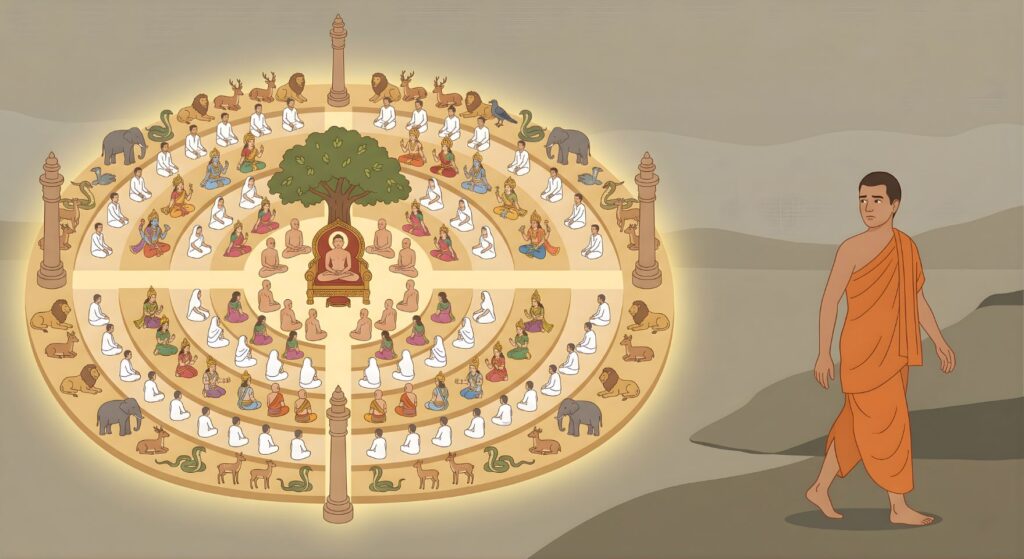
“‘So Marichi abandoned Jain austerity. And with his sharp mind — for he was brilliant, there was no question of that — he himself established the Sankhya school of thought. He led other weak-minded seekers down that wrong path with him. That fallen monk practised his own invented austerities for a long time, fuelled by deep mithyatva.
“‘When he died, the bodily mortification he had undergone — however misguided — earned him rebirth as a god in the fifth heaven, Brahmaloka. He lived there for ten sagaropamas, adored by celestial women who gazed at him with half-closed eyes. But Death came for him too. Who, still revolving in this cycle, is beyond its reach?'”
The Spiral
The monk Amitakeerti’s voice,” said the monk Proshthila to King Nandana, “grew steady and rhythmic as he narrated to the lion the long chain of what followed.
“‘From Brahmaloka, the soul fell. It was born in the city of Kauliyaka as a Brahmin’s son named Maitrayana — a boy whose name meant friendliness, and who did indeed spread maitri wherever he went, even among those with false views. Maitrayana became a Parivrajaka, a wandering ascetic.
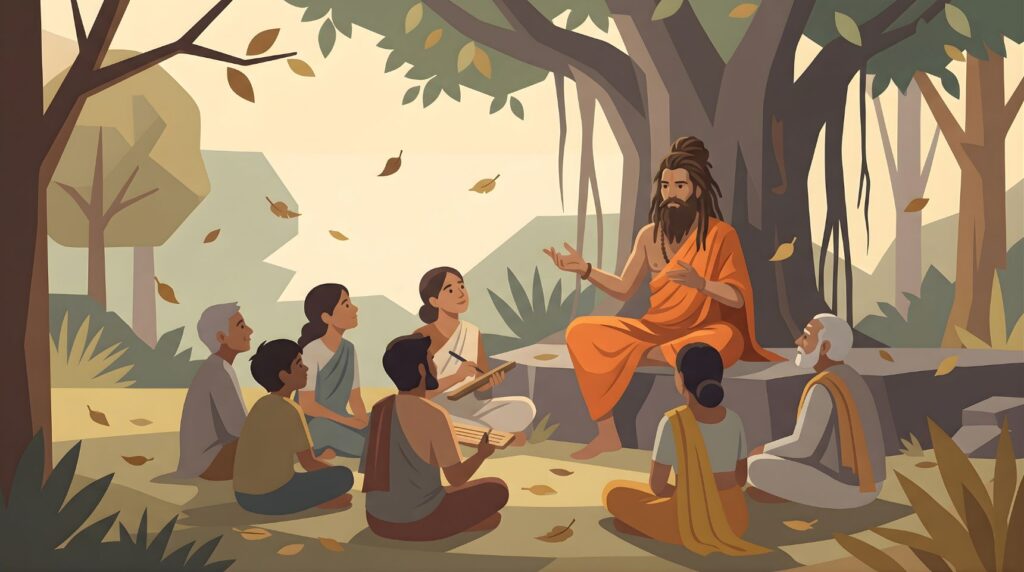
“‘He practised severe austerities, rose to the rank of a teacher of teachers, and was given the title Kritantakrit — Destroyer of Death. But the title was ironic. Death, as though angered by this presumption, came and seized him all the same. He was reborn in the first heaven. He enjoyed divine pleasures. He fell again.”
“Born next as Pushpamitra, a Brahmin’s son in the city of Sthunakara — the child of Bharadvaja and his wife Pushpadanta. He appeared like the very sprouting of the seed of delusion. Unrestrained, desiring heaven, he went to the ashram of the Parivrajakas while still a youth and forcibly took diksha.
Long austerities. Death. Reborn in the Ishana heaven for two sagaropamas — watching the dances of apsaras that followed the music of the Kandarpa-class gods. But just as a maddened elephant throws down its sleeping mahout at the end of the day, heaven cast him down when his merit was spent.”
“‘Born as Agnisaha, son of the fire-tending Brahmin Agnibhuti and his wife Gautami. His body blazed with a radiance like lightning that lit up the directions. Parivrajaka austerities again. Death. Reborn in the Sanatkumara heaven. Seven sagaropamas of divine pleasure. The celestial women seemed to drink up his lifespan with their eyes. He fell.
“‘Born as Agnimitra, in the city of Mandira. Enormous matted locks, as though he were ablaze with the flames of the fire at the end of an age. He abandoned worldly life for the highest austerity — but in the guise of a Parivrajaka, he gave false teachings. Arrogant to the last. He died, went to the Mahendra heaven for seven sagaropamas. And fell once more — bereft of all splendour, like a withered leaf from a tree.
“‘Born as Bharadvaja, in the city of Svastimati — son of the Brahmin Salankayan and his wife Mandira, who was truly a temple of virtues. His parents had been childless before his arrival. He was like Garuda, the king of birds — just as Garuda upholds the glory of the twice-born (birds), this Bharadvaja upheld the glory of the twice-born (Brahmins). Parivrajaka austerities. Death. Mahendra heaven again. Seven sagaropamas — ceaselessly experiencing the pleasures of celestial women, struck by their deliberately long ear-ornaments and sidelong glances.’
“The monk paused before the lion.
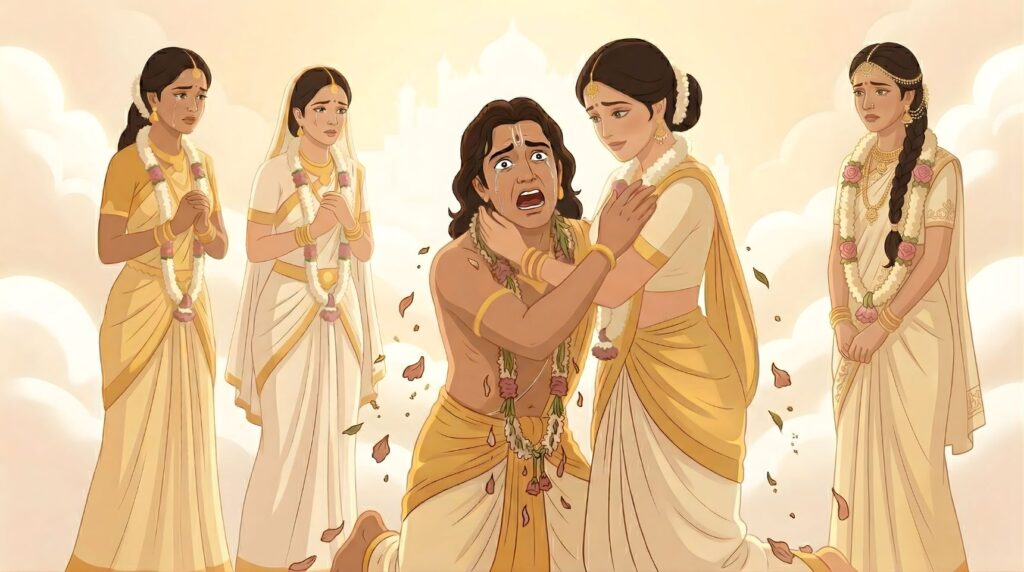
“‘This time, when the signs of departure appeared — the wish-fulfilling trees trembling, the Mandara garlands wilting, his vision wavering — the god wept. His bodily radiance faded. Casting a gaze made desolate by sorrow upon his beloved women, he began to lament.
“‘He cried: The lamp of my merit has been extinguished! My mind is scorched by anxiety! The circle of my hopes, now bereft of all hope, is shrouded in darkness! “
“‘He called to heaven itself: O heaven, adorned with divine women of heavenly grace — why do you not hold me? Me who is falling, me who has no refuge? “
“‘Whom shall I seek refuge in? What should I do? What is my destination? By what means can I cheat Death? “
“‘He clutched at one of his celestial consorts: Embrace me tightly around the neck! Hold back with force these life-breaths that are eager to depart! “
“‘And then he fell — propelled by the sheer weight of his anguish. His bewildered, innocent divine consorts watched him with eyes awash in tears of compassion. What a pitiable sight.’
“The monk let the silence settle.
“‘After that fall, O Lion, the soul — its great merit extinguished, burning with the fever of mithyatva — wandered for an immeasurably long time through wretched births. Mobile and immobile, trasa and sthavara. Experiencing terrible sufferings. Until, by some twist of karma, it obtained human birth once more. And rightly so — for what does this soul not approach, what does it not abandon, and what does it not take on in this world, through the fruition of its self-created karma?
“‘It was born as Sthavara, a Brahmin’s son in Rajagriha — the son of Shandilyana and his wife Parasari. And once again — Maskari austerities. And once again — heaven. Brahmaloka. Ten sagaropamas. Immediately he obtained a divine body adorned with innate jewels, divine garments, Mandara garlands, the fragrance of sandalwood. Surrounded by celestial maidens, all desires fulfilled, that god sported there with great delight.’
“And there,” said the monk Proshthila, “the monk Amitakeerti’s narration to the lion paused. But the story was far from over.”
The soul sits in Brahmaloka, adorned in divine garments and sandalwood, surrounded by celestial women. It has been a hunter, a god, a grandson of the first Tirthankara, a fallen monk, a wandering ascetic — again and again. And the story is far from over.
Part 2 of the past lives of Mahavira continues with a disputed garden, two rival kings, and a war that was written in karma long before either of them was born.